
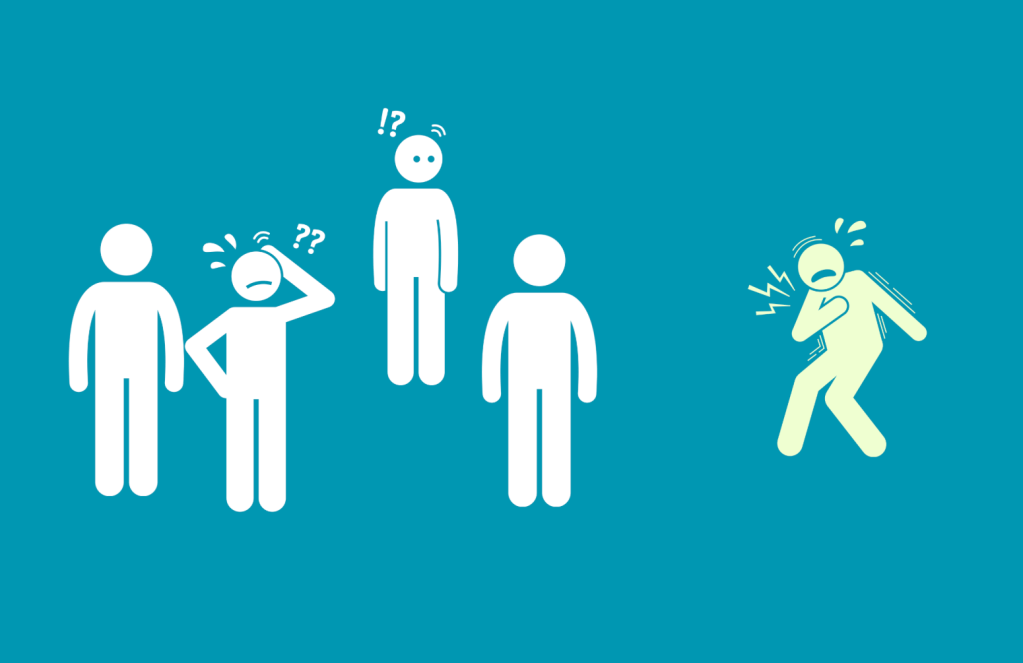

The story of Kitty Genovese may be one of the most infamous in psychology’s history. While sparing the morbid details, the general story is that Kitty Genovese, a 28-year-old bartender, was fatally attacked around 3:00 am while walking to her apartment in the quiet neighborhood of Kew Gardens, Queens. Despite many neighbors witnessing the middle-of-the-night attack, which lasted for over half an hour, nobody came to Kitty’s aid. Two weeks later, on March 27th, 1964, the New York Times published a headline that shocked the nation, “37 Who Saw Murder Didn’t Call the Police.”
The New York Times’ report of the number of witnesses and their supposed failure to act has since been widely disputed. Indeed, one man shouted into the street and several others attempted to call the police. Kitty’s own friend rushed down to the scene at the last minute. But the picture of dozens of New Yorkers watching callously as a tragedy unfolded was already ingrained in the public’s minds. The Kitty Genovese story brought about waves of questioning and fear. Were people really that apathetic? How could neighbors stand by without attempting to help?
In 1968, two social psychologists, John Darley and Bibb Latané at New York University and Columbia University, respectively, set out to answer these questions. They devised an experiment to test a new term they coined “Bystander Intervention.” Bystander Intervention, they theorized, explained why a large number of witnesses were less likely to help than a single witness. They posited that a large group of witnesses would experience a Diffusion of Responsibility, where each individual felt less morally obliged to intervene, assuming that someone else would help instead.
Recreating a tragic emergency situation was not feasible, so Darley and Latané used clever principles of grouping and diversion. They recruited NYU students who were led to believe that the study’s purpose was to discuss their adjustment to college life with other peers. Each participant was put in a room by themselves and told that they would be conversing with either one, two, or five other students, who would speak to them through an intercom system. The supposed number of other students on the call was the independent factor Darley and Latané were interested in. In reality, each participant was merely talking to themselves, and the other students’ stories were pre-recorded messages.
Each “student” on the call went one at a time and shared details of their college experience, and one of the students mentioned that he was prone to epileptic seizures. Midway through the call, this student asked for help through the intercom, accompanied by a convincing recording of someone’s speech as they had a seizure. Darley and Latané were curious how long it would take participants to leave their intercom booths and get help.
In the condition where participants believed that they were the only other person on the line, 100% of the subjects left the booth and ran for help. In the condition where participants believed two others were on the line, only 85% summoned help. Lastly, of the participants who believed six people were on the line, only 60% alerted the experimenters of the emergency. After four minutes, the experiment was ended and the participants were debriefed.
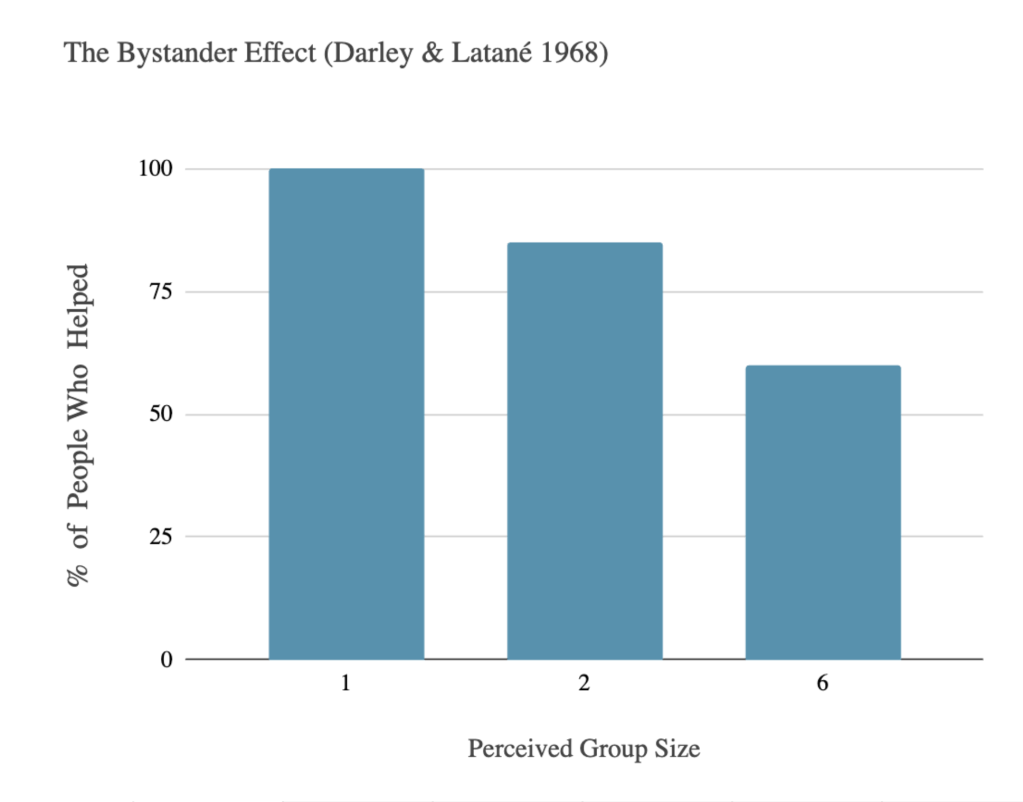
Like Darley and Latané hypothesized, as the number of perceived bystanders increased, participants became less likely to help. It wasn’t that the participants were apathetic—during those four minutes, all participants showed physical signs of distress. Clearly, social forces that discouraged bystanders from acting were at play.
In addition to the Diffusion of Responsibility, participants in perceived larger groups were likely to experience Deindividuation, or a sense of anonymity in the large group and loss of individual identity. With more perceived students on the call, participants felt less singled out and their personal conviction to act wavered. Social conformity forces were also at play. The concept of Social Proof explains that in times of uncertainty, people often use the behavior of others to determine how they should behave. If the other students on the call didn’t seem concerned, participants followed this norm of not getting help themselves. Pluralistic Ignorance, or the tendency to misjudge how everyone else feels, led participants to believe that they were the only ones bothered by the medical emergency. In actuality, a large group may have shared this belief, but each participant mistakenly assumed that everyone else was unperturbed. Evaluation Apprehension or a Fear of Negative Evaluation also held participants back. Too often in emergencies, bystanders fail to intervene out of fear that they will overreact and look foolish. If no one else is helping, bystanders think, then the emergency must not be as bad as it seems. Stepping out of the crowd to help and risking embarrassment can seem much scarier than simply turning the other way. The danger in such thinking is self-evident.
Since Darley and Latané published the findings of their study in a paper titled “Bystander Intervention in Emergencies: Diffusion of Responsibility,” many social psychologists have investigated the Bystander Effect. The Bystander Effect has changed how people view and respond to emergencies, and bystanders’ roles in such situations. In first aid courses, the protocol is now to explicitly single out a bystander in the crowd and instruct them to call 9-1-1, or point to a different person and tell them to get the AED. By clearly designating one person to help, factors that can lead large groups of people to inaction—Diffusion of Responsibility, Deindividuation, Social Proof, Pluralistic Ignorance, and Evaluation Apprehension—are dispelled. While the Bystander Effect may reveal a disheartening aspect of human nature, the effect is easily crumbled once people are aware of its influence. The encouraging revelation is that people overwhelmingly do want to help in emergencies, and most failure to do so is because of complex forces, not a lack of human compassion.
References
Benderly, B. L. (2012, September). Psychology’s Tall Tales. American Psychological Association. https://www.apa.org/gradpsych/2012/09/tall-tales
Darley, J. M., & Latane, B. (1968). Bystander intervention in emergencies: Diffusion of responsibility. Journal of Personality and Social Psychology, 8, 377-383.
Hock, R. R. (2009). Forty Studies That Changed Psychology: Explorations into the History of Psychological Research (6th ed.). Pearson.
 Psychology for Society
Leave a comment