
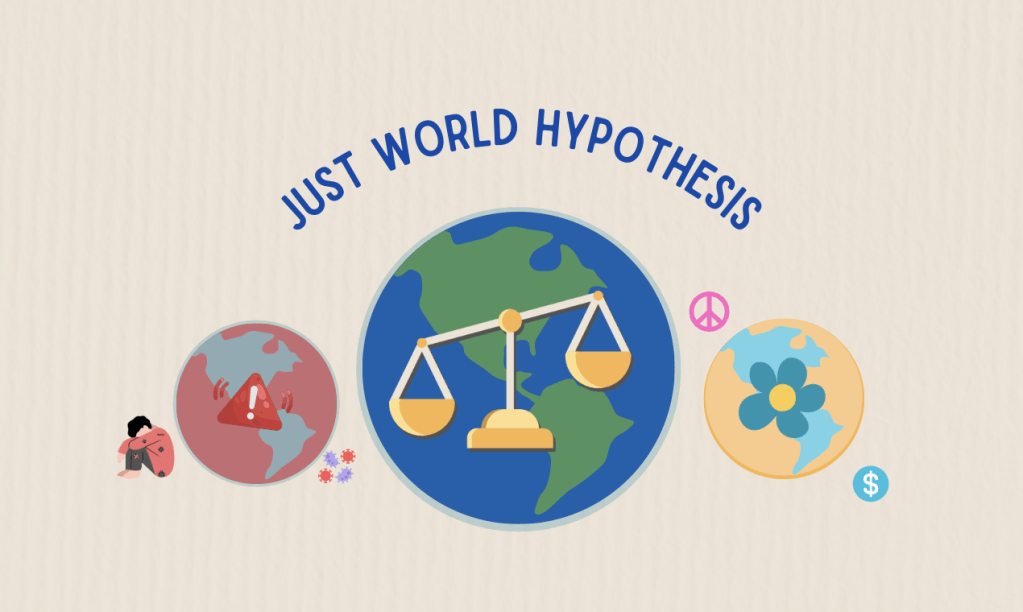

Do you believe in good and bad karma? Or that, in the end, most people get what they deserve? If so, you’re not alone. The Just World Hypothesis establishes that there’s a universal human desire to view the world as fair, and that the mind is biased to make sense of events by assuming that good things happen to good people and bad things happen to bad people. According to the Just World Hypothesis, this prevalent belief that the world is fair is ingrained in the human psyche because it provides a sense of comfort and control. Nevertheless, clinging to the mindset that the world is built on due processes of cause and effect can give way to cognitive bias that rationalizes inequality and impedes social justice efforts. For instance, people may use this belief in a fair world to justify prejudice against less fortunate groups by arguing that the groups deserve their inferiority. The extent to which each individual subscribes to just-world beliefs varies greatly, holding important implications for people’s judgments and political as well as societal views.
The most conspicuous and troubling consequence of just-world beliefs is the phenomenon of victim-blaming, in which victims of crimes like sexual assault are assumed to have done something wrong to deserve their fates. Even in the modern day, victim-blaming is a pervasive reality that breeds sexism and stigma, contributing to toxic sentiments along the lines of victims “asking for it” because of factors like the way that they dressed. This irrational train of thinking is highly problematic and normalizes violence against women as standard male behavior, when the perpetrator should be the only one to blame. Police, courts, and juries often perpetuate victim-blaming on a systematic level, which results in victims not being believed, or worse, being actively shamed or threatened for speaking up. Racial bias interacts with victim-blaming, where Black women are less likely to get the justice that they deserve. According to the National Sexual Violence Resource Center (NSVRC), less than half of all sexual assault cases are reported, and of the ones reported, an NBC News investigation found that fewer than 4% resulted in criminal convictions across major U.S. cities.
Even when people recognize that victim-blaming is wrong, the Just World Hypothesis is founded on innate moral inclinations, and the vestiges of this are hard to shake. The fundamental tenet that good is associated with reward while evil is punished is instilled in people from a young age; for instance, childhood stories and fairytales often revolve around virtuous characters being rewarded with “Happily Ever After.” When people don’t secure good endings or “Happily Ever Afters,” it is only natural for the mind to go back and search for a potential cause or misdeed as a means of explanation. In addition to morality, the Just World mindset is ingrained in human cognition, stemming from the desire to make sense of the world as a predictable system that is within one’s control. People cling to the Just World Hypothesis because of the sense of security it brings; it is reassuring to assume that the homeless teenager or single parent must’ve messed up, and that by acting virtuously, one can avoid similar ill-fates.
Beyond providing a comforting anchor for people’s views, The Just-World Hypothesis serves important purposes—American social psychologist Mark Lerner first proposed it in the 1960s after observing how clinical psychologists disparaged their patients as a defense mechanism. Lerner went on to conduct shock experiments where participants, after experiencing the psychological discomfort of watching innocent people get shocked, grappled with how to make sense of the punishment by devaluing and blaming the shock victims. In this way, the Just World Hypothesis helps people avoid crippling feelings of helplessness, allowing them to stay motivated and optimistically pursue life goals. Just-world thinking often results from people trying to resolve cognitive dissonance in everyday life that comes from witnessing inexplicably bad events while maintaining a belief that the world is fair. Importantly, though, efforts to find explanations can lead people to dangerously distort their perceptions and change their attitudes, like consciously or unconsciously assigning blame.
Since Lerner’s work in the 1960s, psychologists have found various ways to measure people’s levels of just-world beliefs, and Isaac Lipkus’s 1991 “Global Belief in a Just World Scale” has received favorable internal consistency and support. Psychologists have linked a stronger belief in a just world with other foundational values like political conservatism, high regard for authority, and religiosity. Parallels can be drawn between the Just World Hypothesis and the hard-work-begets-success narrative of the American Dream, as well as the celebration of successful people as morally good that has come to define capitalist American culture. There is also something to be said about people leveraging the Just World Hypothesis to make moral critiques of less fortunate others, and thus boost their own self-esteem.
Moving from an individual to a broader societal scale, the Just World Hypothesis, somewhat ironically, often undermines social justice attitudes, leading people to believe that groups like the homeless or poor deserve their fates. Politicians often echo sentiments from the Just World Hypothesis to shift the burden of responsibility away from themselves, for instance, by suggesting that people on welfare deserve their lot in life, while ignoring the root cause of systematic inequality. This hierarchical worldview justifies prejudice against minority groups and leads people to jump to conclusions; slowing down contemplation and engaging in empathy are two solutions to this cognitive pitfall. The Just World Hypothesis is thus often referred to as the Just World Fallacy: it enables people to brush over the policy work that must be done to remedy unfair systems, and ignore the daunting truth about the uncertainty and unpredictability of life.
References
Andre, C., & Velasquez, M. (2015, November 13). The Just World Theory. Markkula Center for Applied Ethics. https://www.scu.edu/ethics/ethics-resources/ethical-decision-making/the-just-world-theory/
Cherry, K. (2023, November 25). What Is the Just-World Phenomenon?. Verywell Mind. https://www.verywellmind.com/what-is-the-just-world-phenomenon-2795304
Krastev, S., & Pilat, D. (n.d.). Why do we believe that we get what we deserve?. The Decision Lab. https://thedecisionlab.com/biases/just-world-hypothesis
Lerner, M. J., & Simmons, C. H. (1966). Observer’s reaction to the “innocent victim”: Compassion or rejection? Journal of Personality and Social Psychology, 4(2), 203–210. https://doi.org/10.1037/h0023562
National Sexual Violence Resource Center (NSVRC) Statistics. National Sexual Violence Resource Center. (n.d.). https://www.nsvrc.org/statistics/statistics-depth
Rubin, Z. & Peplau, L.A. (1975), Who Believes in a Just World?. Journal of Social Issues, 31: 65-89. https://doi.org/10.1111/j.1540-4560.1975.tb00997.x
Walinchus, L., Smyser, K., & Murphy, J. (2025, January 10). A vanishingly small number of violent sex crimes end in conviction, NBC News Investigation shows. NBCNews.com. https://www.nbcnews.com/specials/sex-assault-convictions/#:~:text=U.S.%20news-,A%20vanishingly%20small%20number%20of%20violent%20sex%20crimes%20end%20in,an%20NBC%20News%20investigation%20found.
 Psychology for Society
Leave a comment