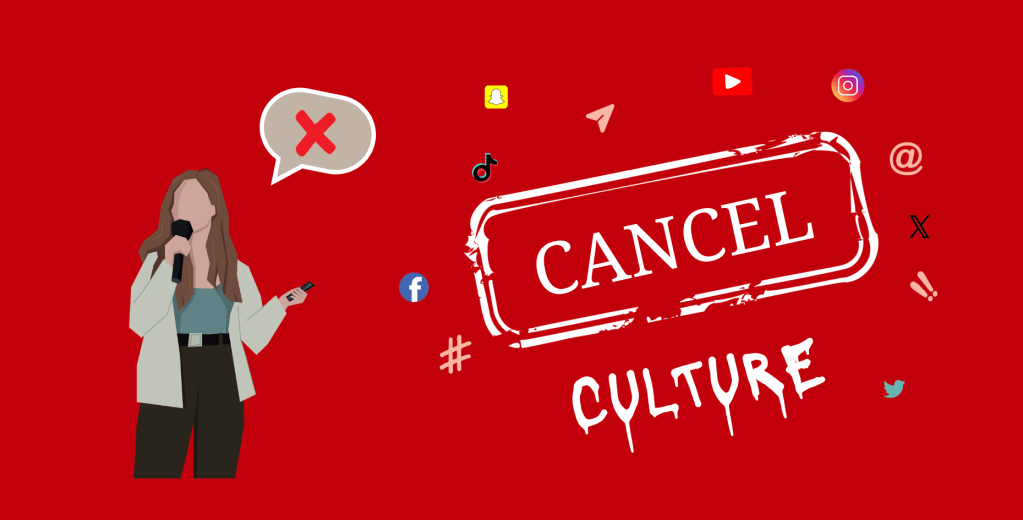

While the phrase “Cancel Culture” only entered mainstream vocabulary within the past decade, it has quickly taken its place alongside the defining forces shaping digital interaction and public discourse today. A unique product of social media, Cancel Culture involves a perceived offender, who usually posts an offensive message or tweet, being “canceled” and publicly shamed by crowds of people online. In many cases, the offender is given little chance to defend their reputation before the general public and the media blacklists, trolls, and blocks them—effectively silencing their voice. While Cancel Culture has been celebrated by some as a way of holding others accountable, the ramifications caused by this large-scale social phenomenon must also be seriously considered. Here, we delve into a discussion of the pros and cons of Cancel Culture, which serves as a fascinating demonstration of group power dynamics and how mob-like behavior can quickly spiral out of control.
The Pros: Pursuing Social Justice, Uplifting Marginalized Groups
While Cancel Culture only emerged as a mainstream phenomenon in the past decade or so, it has historical ties to many marginalized groups like the Black and LGBTQ+ communities, who have used “canceling” as a form of calling out unacceptable behavior. Cancel Culture may be viewed as a reversal of traditional power dynamics, where groups of a lower social standing are able to take back power from higher-status individuals, like celebrities or politicians, who have been deemed as no longer worthy of their social respect or authority. The act of banding together to cancel a disrespectful individual can empower these minority groups and be a source of collective emotional affirmation that validates their perspectives. Along with being symbolically powerful in fostering solidarity, Cancel Culture can lead to meaningful real-world outcomes, in which the canceled individuals lose titles, social prestige, revenue from brand deals, and so forth. In this way, Cancel Culture uniquely enables marginalized groups to take action and control the public narrative, raise awareness, and amplify their voices. In the realm of social justice, Cancel Culture may be viewed as the latest digital evolution of minority groups effectively wielding their collective power, and is similar to successful techniques used in the past, such as boycotts.
The Cons: Mob-Like Behavior, Harmful Psychological Effects
While Cancel Culture enables groups to carry out notions of justice, the act of canceling meaningfully differs from techniques like boycotting because of its highly aggressive aims. Cancelling typically involves not only confronting injustice by stripping the offender of support, but also taking steps further to actively inflict punishment or harm. Cancel Culture is inherently biased because the criticisms are of a one-sided nature—offenders deemed “guilty” are given scant opportunities to defend themselves or tell their side of the story before being lacerated by the court of public opinion. Cancel Culture may be likened to a social contagion that rapidly spreads within groups, inducing individuals who lack informed knowledge of the case to eagerly join in on the attacks merely for the sake of it. The Bandwagon Effect and group conformity can play a powerful role in pressuring individuals to pile in on the slander, as can virtue-signaling, where people engage in the cancellation as a way of touting their moral high ground. Unsurprisingly, Cancel Culture can contribute to a toxic atmosphere of polarized dialogue and stifled free speech, as the offender is stripped of their voice and others become afraid to speak their minds for fear of facing similar backlash. In this way, Cancel Culture poses a large threat to the state of modern-day society, actively sewing division and impeding efforts to forge more open-minded dialogue and collaboration between groups. There is certainly a danger in a society that normalizes, or even eagerly embraces, the opportunity to band together and uninhibitedly tear down strangers online.
On a less societal and more individual level, a second major concern of Cancel Culture is the harmful mental health consequences that it brings. Cancel Culture stirs up anxiety, hatred, and fear on all sides, amongst the hordes of individuals who engage in the cancellation as well as inactive bystanders following along. Canceled individuals experience the worst consequences of all, as they are effectively belittled as worthless and made to feel invisible or small. From the standpoint of evolutionary psychology, social ostracism is one of the worst ordeals that a person can endure, as being shunned by a group greatly reduces the likelihood of survival. Being estranged or cut off in social relationships with others, which plays out tenfold when somebody is canceled, is also linked to depression and mental health instability. As such, it is no surprise that the human brain has a visceral reaction to being canceled, which entails social ostracism on an unprecedented scale and gives rise to incredible emotional and psychological pain. While many individuals who are canceled may unquestionably deserve to be criticized, in many cases the backlash is disproportionate to the offense. Nobody is perfect, and one must consider whether others truly deserve to lose their entire reputations over one poorly thought-out tweet or moment of rash speech.
Conclusion
Overall, Cancel Culture is a highly emotionally-charged, controversial societal trend that plays out in the public spotlight. While gratifying in the short-term, many would agree that Cancel Culture is not a sustainable nor healthy way of pursuing progress, social justice, or positive attitude change. Cancel Culture is a phenomenon made possible by crowds of eager social media users; as such, the power to unravel Cancel Culture is in the hands of each ordinary consumer. As the digital landscape of social media continues to rapidly evolve, people should consider how their individual words and actions can contribute to positive societal change rather than perpetuate division and stir up hurtful energy.
References
Geher, G. (2023, January 25). An Evolutionary Perspective on Cancel Culture. Psychology Today. https://www.psychologytoday.com/us/blog/darwins-subterranean-world/202301/cancel-culture-in-evolutionary-perspective
Toler, L. (2025, July 30). Cancel culture and its mental health effects. Verywell Mind. https://www.verywellmind.com/the-mental-health-effects-of-cancel-culture-5119201
Traversa, M., Tian, Y., & Wright, S. C. (2023). Cancel culture can be collectively validating for groups experiencing harm. Frontiers in psychology, 14, 1181872. https://doi.org/10.3389/fpsyg.2023.1181872
 Psychology for Society
Leave a comment