
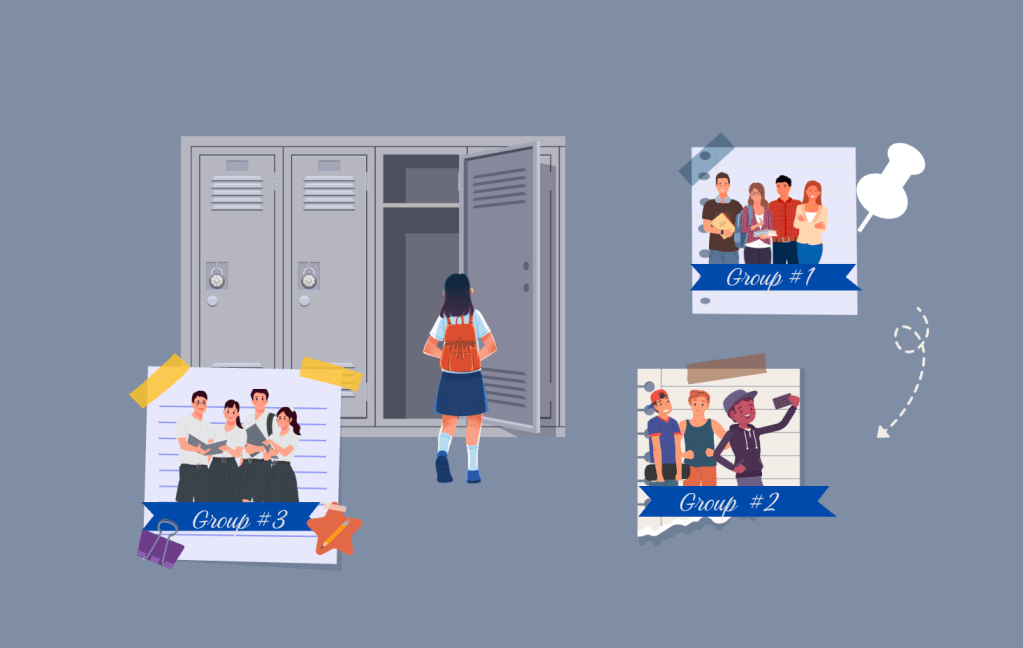

As the start of the school year rolls around, many students anticipate not only the academic aspect but also the various social aspects and environments that the classroom brings. The school social landscape plays a major role in student well-being and behavior, and is often dominated by the presence of cliques, or clearly defined friend groups. A 2022 YouGov poll of 2,000 American adults found that nearly half recalled the presence of “jock,” “popular,” and “cheerleader” cliques at their high schools. Cliques first emerge around middle school, when children naturally begin to feel less connected to their parents and become more drawn to relationships with peers. Additionally, adolescents naturally express a greater desire for popularity around this age. During these years, adolescents form groups to secure a sense of belonging, status, and community. Despite these innocuous intentions, when friend groups become exclusive “cliques,” they can create unhealthy dynamics among both insiders and outsiders of the group. In this article, we examine the psychological aspects of cliques in two ways: the intra-group structure within these friend groups, and the behavior of cliques in the larger context of the school environment.
Intra-group Structure
Like many social groups in the real world, cliques’ internal structure or rankings can be just as fascinating as their position in the broader social ladder. Among boys, cliques typically center around common interests, such as shared hobbies like basketball or video games. Meanwhile, cliques of girls typically revolve around bonds of mutual support and friendship. At the heart of it all, cliques are often stereotypically portrayed as containing a Queen Bee, like Regina George in the 2004 film Mean Girls. In real life, these prominent leaders and hierarchies are very prevalent and help maintain group functioning by providing a sense of stability and direction. Psychologists studying adolescent cliques have identified that these internal ladders usually take a “pyramid” or an “inverse-pyramid” form. In a pyramid hierarchy, a few members dominate the friend group while the majority are low status, whereas an inverted pyramid involves most members enjoying high status and only a few being looked down upon. While true egalitarianism is rare, some friend groups lack a clear leader and instead place members on more or less equal social footing.
How these cliques are internally organized is important because it leads to pronouncedly different dynamics. For instance, friend groups without a clear pecking order may experience more intragroup aggression, as group members constantly jostle for power. Meanwhile, cliques with a pyramidal structure may experience less internal dissent, instead deferring to the opinions of a select leader. These leaders powerfully dictate the clique’s social norms regarding etiquette, clothing, style, speech, and so forth, and their choices have an outsized influence on the behavior of the group. Moreover, many cliques adopt a policy of strong conformity to these social norms, which affects how clique members behave when they are both with and without friends from their clique. Friend groups of boys tend to have more overt hierarchies—feeding into the notion of an “alpha male”—which can lead boys, more so than girls, to engage in risky or reckless behaviors to assert their strength or group position. Notably, psychologists have found that schools with more pronounced social hierarchies typically possess greater levels of bullying, as students lower on the pecking order make for easy targets. Thus, the issue with social cliques perpetuating hierarchal frameworks is clear.
Clique Behavior
In addition to possessing rigid hierarchies, social cliques are notorious for exhibiting certain behaviors. One such behavior is aggression, which psychologists have bifurcated into two strands of physical (tangible) and relational (intangible) aggression. Friend groups of boys typically exhibit greater physical aggression, while girls are more likely to utilize relational aggression through subtle insults or gossip as a way of maintaining control. Aggression may be utilized to deter competing groups or undercut up-and-coming classmates who threaten group members’ social status. Due to the aforementioned power of conformity, cliques often deem it “cool” to behave toward non-members in dismissive or demeaning ways.
Somewhat opposite to aggression, clique members also frequently utilize prosocial behavior, like acts of kindness, to maintain power. For instance, leaders of cliques may wield aggressive tactics like rumor-spreading, yet compensate for this meanness by issuing compliments that maintain their likability. Generally, psychologists have found that the more popular the clique or friend group, the more pronounced these acts of aggression and prosocial behavior are. Interestingly, Pattiselanno et al. (2015) also suggest that group hierarchies organized as inverted pyramid structures, that is, where most members are of a high status, exhibit greater aggression and prosocial behaviors than pyramidal or egalitarian cliques. Perhaps when there are only a few members designated as low status, those members experience heightened tension to fit in and avoid being dropped from the group. Through this mixture of treating others with kindness and cruelty, cliques maintain their image of being simultaneously admired and feared.
Final Thoughts
Overall, social cliques are one of the defining features dotting many high school cafeterias and halls, yet are by no means the full picture. These tight-knit friend groups can provide adolescents with a secure sense of identity and purpose as they navigate their busy lives. However, there is also a risk of adolescents compromising their personal values and becoming wrapped up in the power hierarchies and aggressive behaviors of these groups. In the future, it is critical for teenagers, schools, and parents to have meaningful discussions about how to avoid friend groups turning into exclusive or toxic cliques.
References
Orth, T. (2023, January 17). Americans recall their membership in high school cliques. YouGov. Retrieved August 14, 2025, from https://today.yougov.com/society/articles/45000-americans-recall-membership-high-school-cliques
Pattiselanno, K., Dijkstra, J. K., Steglich, C., Vollebergh, W., & Veenstra, R. (2015). Structure Matters: The Role of Clique Hierarchy in the Relationship Between Adolescent Social Status and Aggression and Prosociality. Journal of youth and adolescence, 44(12), 2257–2274. https://doi.org/10.1007/s10964-015-0310-4
Pickhardt, C. (2021, December 6). Adolescence and the Power of Social Cliques. Psychology Today. Retrieved August 14, 2025, from https://www.psychologytoday.com/us/blog/surviving-your-childs-adolescence/202112/adolescence-and-the-power-of-social-cliques
 Psychology for Society
Leave a comment