


Erik Erikson’s Social Development Theory was developed in the mid-twentieth century to describe how people form their identities in the world, starting with birth and evolving to old age. While Erik Erikson’s neo-Freudian approach has been largely criticized for its lack of scientific basis, some broad concepts are still thought-provoking and relevant to fields like education and parenting. His ideas about the various psychological processes that occur throughout life align with recognizable concepts like Inferiority Complexes, Identity Crises, and Midlife Crises. Although Erikson’s findings should not be treated as absolute in any sense, from a philosophical standpoint they hold merit in understanding how we identify and interact with the world. This article uses characters from the popular Hunger Games series to illustrate the defining characteristics of each developmental stage.
Stage 1: Trust vs. Mistrust (Infancy: 0-1 year)
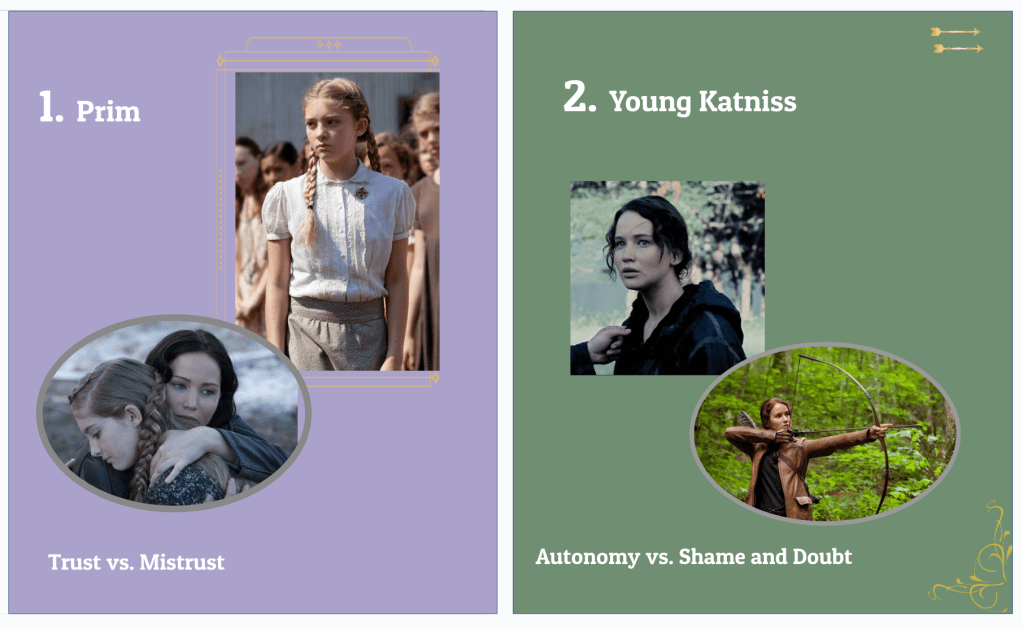
Erikson’s first stage begins with birth and posits that infants develop basic trust in their caregivers based on whether they are dependably cared for. Infants who are adequately nurtured will become trustful of the outside world and develop secure attachment, while—according to Erikson—other infants may develop lasting suspicion and fear if not. Katniss’s younger sister Primrose Everdeen is an example of this. Since Prim was carefully raised and protected by Katniss and her family, she is able to grow up with a stable sense of security despite the harsh conditions of District 12. Later in Prim’s life, she remains trusting and kind even when confronted with the bleak cynicism of the Capitol, thanks to this developmental foundation.
Stage 2: Autonomy vs. Shame and Doubt (Early Childhood: 1-3 years)
In the Autonomy vs. Shame and Doubt phase, toddlers’ sense of independence is forged when they are encouraged to explore their environment. Toddlers who are deprived of doing things on their own can display diminished confidence and doubt in their own abilities. Although many parents and caregivers hover over toddlers, it is vital to allow children to do things by themselves and develop autonomy during this crucial stage. As a child, Katniss was given plenty of freedom to roam around and frequently traveled to the woods to hunt and forage with her father. After her father died, she became the caretaker of the family, which forced her to learn to manage herself and strengthened her survival skills. Throughout the novel, Katniss remains steadfast in her individual abilities to survive the Hunger Games and support the resistance, and rarely doubts herself or feels ashamed.
Stage 3: Initiative vs. Guilt (Preschool Age: 3-6 years)
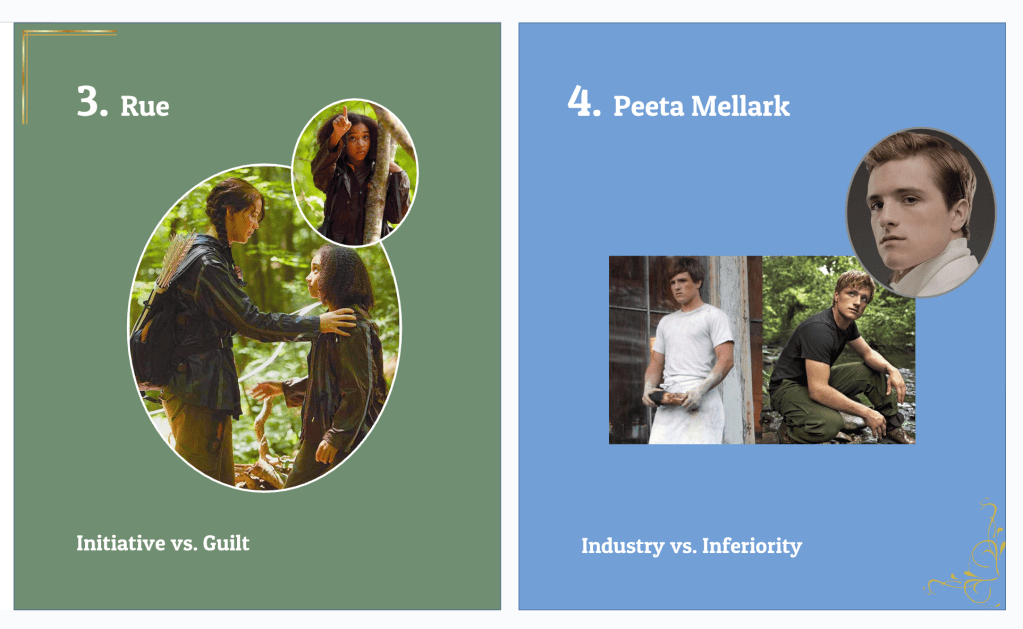
In the third developmental phase, young children who are able to start new activities and tackle challenges grow more confident, while children who face discouragement may feel guilty for trying. Children should be encouraged to not only act independently but also to initiate tasks and come up with their own ideas. Rue, a young girl who Katniss allies with inside the Hunger Games arena, demonstrates an initiative to approach Katniss and use her wits to survive. Rue’s ability to succeed at new strategies like remaining in the trees and making tools allows her to develop a stronger sense of confidence and surpass expectations. Conversely, Katniss experiences guilt for trying to help Rue after Rue tragically dies.
Stage 4: Industry vs. Inferiority (School Age: 6-12 years)
In Stage 4, older children learn to dedicate themselves to new tasks, and external achievements reinforce their sense of abilities. Being successful allows children to continue developing their skills, while failures can lead to a lingering sense of doubt and inferiority. This stage is about letting children know that they are competent and doing a good job. This sense of being good at something—whether writing, a sport, or an instrument—helps children create a basis for their rapidly evolving identities. Peeta Mellark is a shy boy from District 12 who is not initially perceived as sharp or fearsome, having lived a relatively easy life. However, Peeta is dedicated to surviving and learning, and his ability to do well in the Hunger Games fuels his confidence. He learns the satisfaction of effectively applying himself, and, as a result, becomes more dedicated to supporting Katniss. He later remains resilient and industrious when tortured by the Capitol and emerges as a hard-working leader.
Stage 5: Identity vs. Role Confusion (Adolescence: 12-18 years)
Around adolescence, children further develop their sense of identity by experimenting with different roles. Success in this stage leads to adolescents forging a stable sense of their values and self. Failure can lead to role confusion, where adolescents are unsure about who they are and their chosen direction in life. Teenagers may try out different social identities to define who they want to be—a football player, a dancer, an engineer. As Katniss grows into adolescence and progresses through the Hunger Games, key questions about her identity emerge and the plot revolves around an internal conflict. Katniss initially occupies the role of a brave survivor of the Games, but is later compelled to become the face of the rebellion as the “Mockingjay.” During this stage of trying on different identities, Katniss questions who she has become and whether her role is being used to incite violence. She struggles with her community and relationships, and must develop a stronger belief in herself and her complex identity.

Stage 6: Intimacy vs. Isolation (Young Adulthood: 18-40 years)
In young adulthood, people begin to navigate and form meaningful relationships to gain a sense of intimacy. Success in this stage leads to close bonds and a strong social identity, while a failure to connect with others results in loneliness and isolation. Gale Hawthorne is a key character who is Katniss’s childhood friend and hunting partner, but nevertheless experiences rough patches in his relationship with Katniss after Katniss returns from the Hunger Games. When Katniss pushes him away, Gale is unable to fully understand her and retreats from these social connections. Gale grows frustrated by this loss of relationship, and his bitterness causes him to make drastic, morally ambiguous decisions about military tactics that ultimately alienate him from Katniss. At the end of the novel, Katniss chooses Peeta over Gale because of Gale’s failure in this stage.
Stage 7: Generativity vs. Stagnation (Middle Adulthood: 40-65 years)
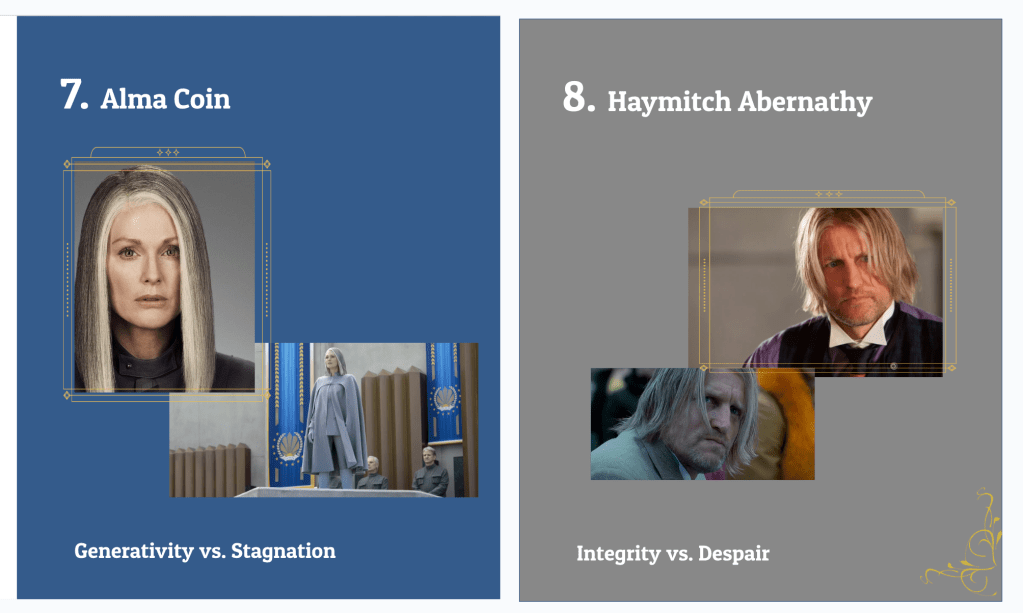
During middle adulthood, people try to be generative and contribute to society for the benefit of future generations. People who are unable to fulfill their purpose or complete their legacy may feel stagnant, experience crises, and feel disconnected. Interestingly, while mid-life crises seem very prevalent, contemporary statistics only display a slight dip in people’s well-being that occurs around the late 40s. Many people switch careers or re-evaluate their lives around this time period. Alma Coin, the callous leader of the rebellion, is an example of the desire to leave a mark along with the stagnation that accompanies this mid-life stage. Alma pretends to lead the rebellion to contribute to positive change for future generations but ultimately betrays Katniss and others for her own personal gain. This failure to achieve meaningful aims and virtues causes her to become shortsighted and leads to her downfall.
Stage 8: Integrity vs. Despair (Late Adulthood: 65+ years)
Lastly, as older age nears, people reflect on their pasts and whether their lives were meaningful and full of virtue or whether they regret past decisions. Their analysis of how “well” they did can either lead to stronger satisfaction with their identity, or a sense of impending despair. Notably, contemporary research has revealed that older adults actually tend to be happier than younger ones and experience greater life satisfaction. Haymitch Abernathy, who is Katniss’s mentor for the Hunger Games, exemplifies the despair some people feel in this stage due to buried trauma from his life. Haymitch regrets his lack of integrity and inability to protect previous Hunger Games tributes and is portrayed as bitter, drunk, and unhelpful because of this. However, in this final developmental stage Haymitch is able to redeem himself and develop integrity by working with Katniss to help the rebellion succeed.
 Psychology for Society
Leave a comment