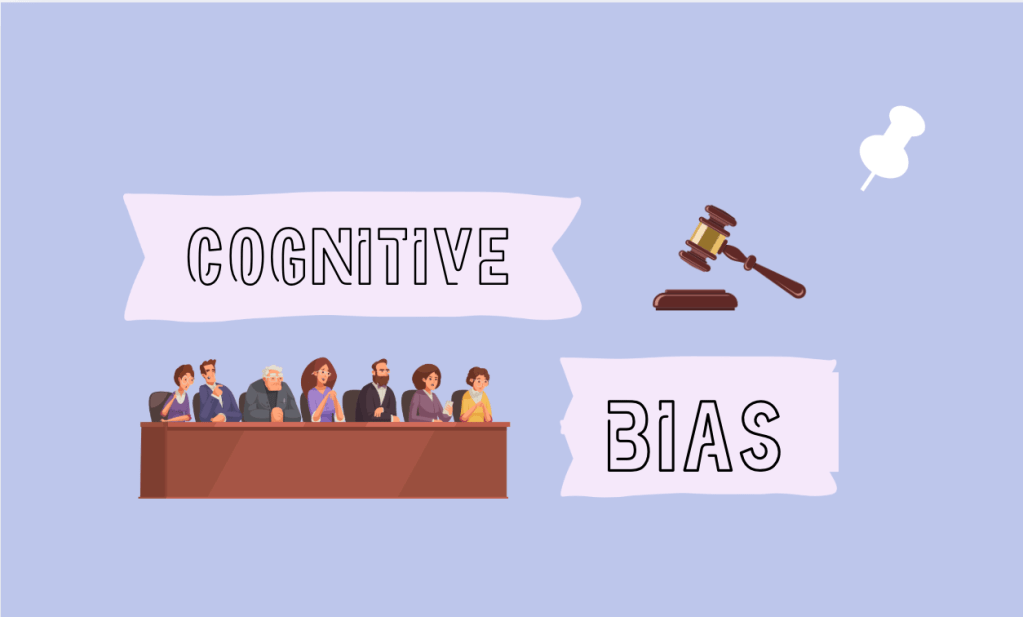

The jury system is a long-standing judicial tradition that embodies fair, democratic decision-making—in theory at least. In the United States, panels of juries hear both civil and criminal cases and are tasked with deciding a defendant’s guilt or awarding damages and sentencing. The concept of a jury first arose from the belief that a trial by peers would protect citizens from the reach of a tyrannical government. Importantly, the underlying assumption is that while a single judge or juror may be biased, a large enough group of citizens should balance each other’s opinions out and reach more objective decisions. This premise seems robust—juries often deliver credible verdicts, and judges concur with the jury about 75-80% of the time. However, the jury system has also received its fair share of scrutiny. One prominent cause for concern is that, since jurors receive little training besides complicated judicial instructions, they are susceptible to faulty decision-making and subjectivity. Jurors commonly resort to using heuristics, or mental shortcuts and rules-of-thumb, rather than algorithmic, deliberative thought processes. Additionally, cognitive biases play a large role in how jurors perceive and weigh evidence. Overall, it is safe to say that throughout the pre-trial, hearing, and jury deliberations, juror decision-making is susceptible to the same biases and blind spots that plague the human psyche.
Preconceptions and Biases
Before the trial even begins, juror preconceptions have been found to play a small but significant role in predicting final verdicts. As previously mentioned, the jury system rests on the belief that by instating a panel of jurors, any individual biases will cancel out, allowing the overall rationality of the group to be preserved. The issue with this assumption is that juries are often composed of a homogeneous group of citizens with similar life experiences, whose biases may compound rather than negate each other. Juror opinions should be formed based on evidence presented in the courtroom alone. Despite this, research has found that juries struggle with disregarding inadmissible evidence, even under instructions from the judge. Pre-trial bias can arise from media coverage and public opinion, as well as a juror’s personal experience and political tendencies. Certain individuals, such as those who are anti-establishment, are naturally more inclined to lean toward the defending side or the prosecution, and tests like the Juror Bias Scale can assess these traits. Unfortunately, even with rigorous jury selection, some level of juror bias is unavoidable—human perception, in itself, relies on past knowledge and experiences to construct reality.
Juror preconceptions are dangerous because they can lead to Confirmation Bias that powerfully distorts how all subsequent evidence is perceived. The widely accepted Story Model posits that juries make sense of testimony by constructing a narrative of what is likely to have occurred. Courtroom evidence is often very contradictory and murky, and jurors may lean on preconceptions to decide which storyline to believe. Confirmation Bias states that once an individual reaches a conclusion, they are likely to favor information that supports the conclusion and dismiss information that doesn’t. As such, once a juror decides on a certain narrative, Confirmation Bias leads them to construe subsequent evidence to match this pre-existing belief. Without realizing it, jurors may find themselves readily believing dubious testimony or overlooking disconfirming facts, in a good-faith attempt to make sense of what happened. While jurors are supposed to constantly revise their opinions based on new evidence, the adage “you see what you want to see and hear what you want to hear” can lead to misinformed and unjust convictions.
Once these juror preconceptions and first impressions have been formed, the tense hours in the thick of the trial are another place where cognitive biases can arise. Indeed, one 2011 case study published in PNAS found that the time of day significantly predicted how likely defendants were to be granted parole by a panel of judges. Due to a phenomenon known as Decision Fatigue, the mental strain of making hard decisions accumulates over time and is incredibly taxing. In this 2011 study, Danziger et al. found that the panel of judges was much more likely to grant parole at the beginning of the day and directly after breaks—highly concerning findings, given that verdicts should be based on objective analysis, not the judges’ moods.
Among jurors, mental exhaustion and a lack of experience impede executive functioning and set the stage for cognitive biases to arise. Hindsight Bias, or the feeling of I-knew-it-all-along, occurs when, after learning the sequence of events, the vast majority of individuals confidently proclaim that they could have predicted the outcome from the start. For instance, in cases of medical malpractice where a patient ended up seriously ill, jurors may condemn the doctor for negligence under the impression that the outcome was inevitable, and the doctor should have known better. With hindsight on their side, jurors forget that the doctor was merely acting with limited knowledge at the time and did not have the benefit of knowing the end result of what occurred. Similarly, Attribution Bias describes the human tendency to overestimate the extent to which a situation was due to an individual’s traits rather than situational factors. A classic example is that when a job candidate is late for an interview, the candidate is often described as inherently lazy or incompetent, while the role of external factors like highway detours is underappreciated. While hearing cases, jurors may assign blame to the defendant’s failures of character—ill-intent, recklessness, rebelliousness, and so forth—while underestimating the role that situational factors played. This bias results in a significant logic error, known as the Fundamental Attribution Error, that skews an objective assignment of guilt.
Heuristics
In addition to cognitive biases skewing perception, even when jurors try to make objective judgments, they commonly fall into the pitfall of using heuristics, or decision-making shortcuts based on rules of thumb, rather than truly analytical, sound logic. A common heuristic is the Representative Heuristic, where the likelihood of an event is judged based on how closely it aligns with a certain stereotype. This heuristic is very problematic and can lead to racial bias, where defendants who look like stereotypical “criminals” are incorrectly deemed as more likely to be guilty themselves. Arguably, the largest tragedy of the court system is the much higher rate of wrongful convictions among racial minorities and the profound human suffering this causes. Jurors also utilize the Availability Heuristic, where events that are quickly called to mind, namely, emotionally salient or vivid memories, are perceived as more prevalent and likely to occur. Jurors are also more likely to recall disturbing or distressing pieces of evidence, and as a result, lawyers on both sides may rely on emotionally heavy narratives to make their evidence seem more prominent. Similarly, due to the Affect Heuristic, individuals may use emotions to make decisions, and, in the face of unclear evidence, jurors may favor the side that makes them feel better. Subtle cues like body language, physical attractiveness, and tone can lead jurors to make snapshot assessments of a witness’s credibility. Oftentimes, jurors are influenced by Framing Effects of how the arguments are presented—the emotions, theatrics, facial expressions—without critically examining the plausibility of the statements themselves.
Jurors are also highly influenced by expert testimony, which begets improper evaluation of the facts through a phenomenon known as the Authority Heuristic. Due to the Authority Heuristic, juries are predisposed to believe seemingly credible figures, and are often unduly swayed by specialist evidence. Typically, experts brought in by either side give subjective commentary on the evidence; nevertheless, the jury may mistakenly interpret mere opinions and speculations as solid facts. Another logical pitfall is jurors’ tendency to be very convinced by forensic evidence, partly due to the expectation that scientific evidence will provide an accurate answer. Even if the forensic evidence is inconclusive, jurors often have trouble understanding scientific jargon and—based on societal expectations largely perpetuated by crime shows—will take the mere presence of forensic evidence as “proof” of a crime. The dangers of facts being misinterpreted are self-evident. Commonly, jurors also lack the proper knowledge of how much money to award in damages and settlements. Without sufficient information, jurors will utilize the Anchoring Bias, wherein they latch onto the first numbers suggested to them and arbitrarily use those numbers as reference points. While these heuristics are useful for making quick choices in everyday life, they can have catastrophic effects when used to make high-stakes decisions about people’s livelihoods.
Group Pressures
Once the jurors have processed the hearings and some of these cognitive biases and heuristics have come into play, jurors then convene and discuss amongst themselves. This final discussion to reach a majority or unanimous decision introduces a host of other psychological factors. Group phenomena such as groupthink, where the group becomes bent on a particular course and silences internal dissent, can stymie productive evaluation. The strong motive to avoid a deadlocked or “hung” jury can lead to conformity and intense group pressures, where jurors ignore certain evidence to preserve a united front. Due to the obligations of civic duty and moral responsibility, jurors can experience high levels of stress during and following their service. Jurors forced to make difficult decisions may experience deep regret, and therapy is crucial in helping jurors move on.
Conclusion
Altogether, the jury system is one of the great triumphs of democracy and justice, but it is not without its susceptibilities. Like all humans, jurors are subject to skewed perceptions and prone to prematurely jumping to conclusions through the Confirmation Bias. Hindsight Bias, Attribution Bias, and Anchoring Bias are also highly relevant to jury decision-making. Additionally, when making quick judgments, jurors are influenced by certain factors like stereotypes, vivid details, emotions, and perceptions of power, which correspond to the Representative Heuristic, Availability Heuristic, Affect Heuristic, and Authority Heuristic, respectively. Given the high stakes of jury decisions, measures should be taken to ensure that ordinary citizens are informed of these cognitive biases and heuristics that can perpetuate prejudiced and inaccurate sentences. Juries should receive more training about how to properly analyze evidence and be given clear judicial instructions. Another simple solution would be for courts to consider adding in more break time to reduce cognitive depletion and Decision Fatigue, which begets more biased, surface-level thinking. While juror pre-trial bias will always exist, trying to enlist a more diverse group of jurors with different biases can also be a great place to start to mitigate these effects. Ultimately, juries are just one microcosm for studying the complex factors that sway human decision-making, and the careful deliberation of juries is vital to upholding freedom and integrity.
References
Bornstein, B. H., & Greene, E. (2011). Jury Decision Making: Implications For and From Psychology. Current Directions in Psychological Science, 20(1), 63-67. https://doi.org/10.1177/0963721410397282
Curley, L. J., Munro, J., & Dror, I. E. (2022). Cognitive and human factors in legal layperson decision making: Sources of bias in juror decision making. Medicine, science, and the law, 62(3), 206–215. https://doi.org/10.1177/00258024221080655
Danziger, S., Levav, J., & Avnaim-Pesso, L. (2011). Extraneous factors in judicial decisions. Proceedings of the National Academy of Sciences, 108(17), 6889-6892.
Fine, H., & Curley, L. (2024, March 4). A crucial discourse on our jury system. BPS. https://www.bps.org.uk/psychologist/crucial-discourse-our-jury-system
Oeberst, A., & Goeckenjan, I. (2016). When being wise after the event results in injustice: Evidence for hindsight bias in judges’ negligence assessments. Psychology, Public Policy, and Law, 22(3), 271.
Shaw, K. (2011, April 11). To Get Parole, Have Your Case Heard Right After Lunch. Wired. https://www.wired.com/2011/04/judges-mental-fatigue/
 Psychology for Society
Leave a comment